Home
/
Blog
/
Part 10: Data Security and Compliance

Part 10: Data Security and Compliance

What hotels need on data security and compliance in 2026: GDPR posture, EU residency, vendor due diligence, audit logs, and the contract terms that actually matter.

Bram Haenraets
Co-founder & CEO
Updated
May 3, 2026

More in the Hotel Tech Stack series:

â€

Disclaimer: The insights and discussions presented in this blog series are intended to provide a broad overview of modern hotel technology stacks. The content is designed for informational purposes and may not reflect the most recent market developments. Every hotel's needs and circumstances are unique; thus, the technology solutions and strategies discussed should be tailored to meet specific operational requirements. Readers are advised to conduct further research or consult with industry experts before making any significant technological investments or strategic decisions.

Introduction to Data Security in Hospitality

Hotels collect a lot of sensitive data: passport scans, card details, dietary needs, occasionally medical notes when a guest asks for a hypoallergenic room. Protecting it is partly about regulation and partly about not waking up to a story in The Times. Breaches in hospitality have a particular flavour because the data is rich (identity plus payment plus location) and the perimeter is wide: a chatbot vendor, a Wi-Fi provider, a marketing tool. The discipline below is what serious operators put in place. The team running a digital concierge conversation, or any AI tool talking to guests, sits squarely inside that perimeter and needs the same scrutiny as the PMS.
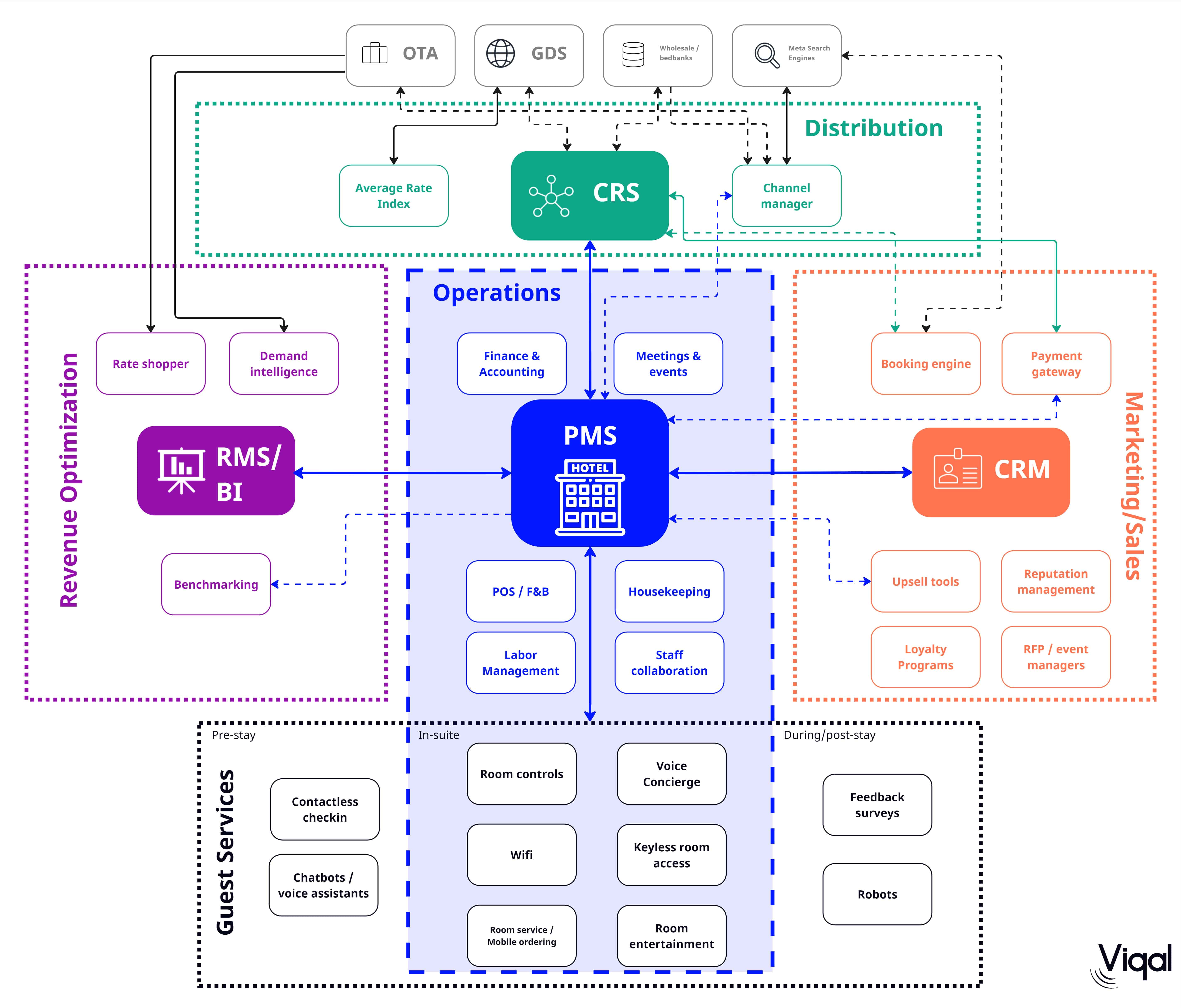
Explore the intricate network of hotel technology and the vital role of data security in safeguarding guest information.
Protecting Guest Data in the Complex Web of Hotel Technology

â€

Understanding Compliance Regulations

For European operators, GDPR is the regulation that matters most. It rests on a few principles worth re-reading every year: a defined lawful basis for processing (Article 6), data minimisation (Article 5), the right of access and erasure (Articles 15 and 17), and breach notification within 72 hours (Article 33). The fines are not theoretical. Marriott was fined GBP 18.4 million by the ICO in 2020 over the Starwood breach. H&M took a EUR 35 million GDPR fine in the same period. Smaller properties are not exempt. The local DPA in your country can and does act on complaints from individual guests. One pattern we see often: a hotel keeps reservation history forever 'in case the guest comes back', without a documented retention policy. That is the easy GDPR violation. Below are the regulations to know:

  1. General Data Protection Regulation (GDPR): the EU regulation governing personal data. Hotels must obtain a lawful basis to process guest data, inform guests about how it is used, and honour access, correction and deletion requests. Penalties go up to EUR 20 million or 4% of global annual revenue, whichever is higher.
  2. California Consumer Privacy Act (CCPA): grants California residents rights over their personal information, including the right to know what is collected, opt out of sale, and request deletion. Properties hosting Californian guests need clear privacy notices and a way for guests to exercise these rights.
  3. Payment Card Industry Data Security Standard (PCI DSS): not a law but a contractual requirement from the card networks. Hotels handling card data must comply or risk losing the ability to take payments. The practical move in 2026 is to use a tokenised payment provider (Adyen, Stripe, Mews Payments) so the property never touches raw card numbers and PCI scope drops to SAQ-A.
  4. HIPAA: applies if a hotel offers medical services. Protected health information needs strict safeguards and the penalties are significant.
  5. COPPA: kicks in when a hotel collects data from under-13s. Parental consent and clear notices are required.
  6. CPRA: extends California rights, including the ability to limit data sharing.
  7. Breach notification laws: several jurisdictions require notification to affected guests and authorities within a defined window. GDPR is 72 hours.
  8. International transfers: moving guest data outside the EU/EEA needs a transfer mechanism, typically Standard Contractual Clauses post-Schrems II, or an adequacy decision. Anyone using a US-only chatbot vendor without DPF certification is exposed here.
  9. Retention rules: different obligations by country. The German Handelsgesetzbuch requires keeping commercial records for 10 years, but that does not mean keeping marketing-consent data for the same period.

â€

Securing the Hotel Tech Stack

Breaches in our industry rarely come from sophisticated nation-state actors. They come from a phished front-desk password, an unpatched server in a back office, or a third-party integration with an open token. The PMS, POS and any guest-facing tools all hold sensitive data, and the protection job is mostly about doing the basics consistently.

Encryption

â€Encrypt data at rest (AES-256 is table stakes) and in transit (TLS 1.2 or 1.3). If a laptop is stolen or a database is exfiltrated, encrypted data is mostly noise to the attacker. Card data should never sit on the property's systems in raw form. That is what tokenisation is for.

Firewalls and segmentationâ€

Firewalls keep external traffic to expected paths. More usefully, network segmentation keeps the guest Wi-Fi away from the back-office VLAN, the PMS away from the smart TV management console, and the IoT devices in their own bubble. Most large-scale hospitality breaches have a story of a flat network somewhere in the chain.

Secure networksâ€

A password on the staff Wi-Fi is not security. WPA3 enterprise authentication, regular rotation of pre-shared keys for any guest-facing networks, VPN access for remote PMS work, and an honest map of what is on the network. How many properties can produce that map on demand? Far fewer than you would think.

Endpoint security

Every device on the network is a potential entry point. EDR tooling on workstations, MDM on staff phones, and a clear policy on personal devices touching hotel systems. The latter is where small properties tend to slip: the GM uses their personal laptop to log into the PMS from home, and that laptop has not seen a security update since 2022.

â€

Data Security Best Practices

Three things, done consistently, beat any single piece of expensive software:

Employee training and awareness

  • Continuous education: a quarterly 30-minute session on phishing, password hygiene and incident reporting beats an annual lecture nobody remembers. Use real examples that hit hospitality (fake OTA invoices, fake Booking.com extranet emails, both very common).
  • Role-specific training: front desk staff need different content from finance, who need different content from IT.
  • Security culture: the goal is for a receptionist to feel comfortable saying 'this email looks weird' to a duty manager and have it actioned. That cultural shift is worth more than any tool.

Regular security audits and penetration testing

  • Internal and external audits: an annual external audit catches what the team has stopped seeing.
  • Penetration testing: a yearly pen test on guest-facing systems (booking engine, Wi-Fi captive portal, guest app) is the right baseline.
  • Remediation: every finding gets an owner and a date. Without that, the audit becomes a filing cabinet exercise.

Incident response planning

  • Response plan: who declares an incident, who calls the DPA, who briefs the GM, who talks to guests. Written down, on paper, available offline.
  • Updates and training: review the plan twice a year. Threats change.
  • Simulation exercises: run a tabletop incident once a year. The first one is always uncomfortable, which is the point. Better to feel uncomfortable in a meeting room than at 2am during a real breach.

Get these three right and you cover most of the realistic threat surface in a hotel. The rest is paid attention rather than expensive software.

â€

â€

The Role of Technology in Ensuring Compliance

Compliance does not need to be done by hand. Two technology approaches do most of the heavy lifting in a hotel context:

Automated tools for monitoring compliance

  • Compliance software: tools like OneTrust, Securiti and Didomi handle consent management, retention enforcement and subject access requests. For mid-size groups they pay back inside a year purely on staff time saved.
  • Real-time alerts: a system that flags a retention breach the day it happens is worth far more than a quarterly report that finds it three months later. Same goes for unauthorised data exports.
  • Integration with existing systems: compliance tools have to plug into the PMS, the CRM and the marketing stack. A standalone compliance tool that nobody reconciles is theatre.

AI and machine learning in threat detection and prevention

  • Threat detection: behavioural analytics on the network catch the unusual login at 3am from a country no member of staff is in. SIEM platforms like Microsoft Sentinel, Splunk or Elastic Security are now within reach of mid-size groups.
  • Predictive analysis: looking at patterns in failed login attempts and lateral movement to spot an attacker before exfiltration begins.
  • Continuous learning: model retraining on the property's own traffic so anomalies become more meaningful over time.

Between automated compliance and behaviour-based threat detection, you cover most of the ground a hotel needs without putting a CISO on payroll.

â€

Challenges and Solutions

Challenge: protecting against cyber attacks

  • Solution: layered defences, meaning firewall, EDR, MFA on every administrative system, and regular patching.
  • Case study: an EU group hit by a ransomware attempt traced the entry point to a single MFA-less admin account on the PMS. Post-incident, MFA went on every back-office login and a 24/7 monitored EDR was deployed; subsequent attempts were blocked at the endpoint.

Challenge: maintaining GDPR compliance

  • Solution: a documented Record of Processing Activities (ROPA), DPAs with every vendor, defined retention windows, and a working subject-access-request process.
  • Case study: a European chain rolled out a data governance platform after an SAR backlog of 90 days. Within six months they were responding inside the regulatory window with the right data, not just the easy data.

Challenge: insider threats and human error

  • Solution: role-based access control, least privilege, and training that does not put people to sleep.
  • Case study: a boutique property had a leak after a former employee retained PMS access for three weeks post-departure. The fix was joiners-movers-leavers automation tied to the HR system. Boring, effective.

Challenge: third-party risk

  • Solution: a vendor security questionnaire that you actually read, an inventory of every system holding guest data, and contractual right-to-audit clauses where the data is sensitive.
  • Case study: a chain reliant on multiple OTA and reservation vendors instituted quarterly vendor reviews and a security questionnaire as a precondition to renewal. Two vendors were dropped after they could not produce a recent SOC 2 or ISO 27001 report.

Challenge: rapid response to data breaches

  • Solution: a tested incident response plan, with the 72-hour GDPR clock visible to everyone involved.
  • Case study: a luxury group rebuilt their incident response process after a slow notification on a prior breach. Tabletop exercises every six months and a 24/7 on-call rotation cut subsequent reporting time from days to hours.

â€

Emerging Threats and Future Defenses

The threat picture changes year over year. The 2026 view, with the caveats that come with any prediction:

Predicted future cybersecurity threats

  • Sophisticated phishing: AI-generated emails and voice clones that get past staff who would have spotted last year's badly-translated phish.
  • IoT vulnerabilities: smart locks, smart TVs and in-room sensors expanding the attack surface, often with patching cycles measured in years rather than weeks.
  • Ransomware evolution: targeted attacks against properties and groups, often double-extortion (encrypt the data, then threaten to publish guest records).
  • AI-powered attacks: automated reconnaissance and credential stuffing at scale.
  • Supply chain attacks: a compromised vendor pushing a tainted update into multiple properties at once.

Emerging technologies for defence

  • AI and machine learning: behavioural detection on every endpoint and network segment.
  • Blockchain: useful in narrow places (loyalty point integrity, identity verification), oversold in most others.
  • Zero trust: verify every request, never assume internal traffic is safe. Slowly becoming the default architecture for new deployments.
  • Quantum cryptography: not yet a practical concern for hotels; worth tracking.
  • Automated patching: less glamorous than zero trust, far more effective in the short term.

The pattern is the usual one in cybersecurity: most of the value sits in the unglamorous things done consistently, with a thin layer of newer technology on top.

â€

Conclusion

Data security is not the part of the operation that gets photographed for the brand book. But it is the part that, if it fails, undoes a decade of work on reputation and guest trust. The job for an operator in 2026 is unromantic: pick vendors with credible security postures, sign DPAs that mean something, train the team, log everything, and rehearse the day a breach happens.

  • Guest trust: the currency that breaks first when a breach lands. Once it goes, marketing budgets cannot win it back quickly.
  • Regulatory compliance: GDPR, CCPA and PCI are not optional. The fines are public and the precedents are established.

Data has weight in 2026: financial, legal and reputational. Properties that treat security as part of operations rather than an IT line item come out ahead. The boring discipline of doing the basics every quarter is, in the end, what protects guests and protects the business.

← Previous: Part 9: Integrations and APIs  |  Next: Part 11: The AI Operator Layer of the Hotel Tech Stack →

Written by
Bram Haenraets
·
Co-founder & CEO

Bram is an entrepreneur focused on AI, hospitality, and digital product innovation. He writes about technology, automation, growth, and the future of hospitality.

FAQ

Frequently asked questions

Robust encryption for data at rest and in transit, properly configured firewalls, network segmentation beyond a basic Wi-Fi setup, current endpoint security on every device, and a written incident response plan. Hotels that get those basics right cover most of the realistic threat surface; the rest is consistency.

Compliance protects hotels from fines and protects guest trust. The main regulations: GDPR for EU citizens' data, CCPA and CPRA for California residents, PCI DSS for payment card security, HIPAA where medical services are offered, and COPPA for under-13s. Each carries its own requirements and penalties for non-adherence.

AI and machine learning power behavioural threat detection, catching unusual logins or lateral movement that rule-based tools miss. Automated compliance platforms handle consent, retention and subject access requests at scale. Together they let mid-size groups run a credible security posture without a CISO on payroll.

Excessive data retention beyond reservation needs, and unsanctioned third-party data sharing (typically with marketing platforms or chatbot vendors without proper Data Processing Agreements). Hotels often retain guest data indefinitely 'in case of return' without a defined retention policy. That alone is a violation.

Use a tokenised payment layer (Mews Payments, Cloudbeds Payments, Adyen, Stripe) so card numbers never touch the property's systems. This drops PCI scope from SAQ-D (most stringent) to SAQ-A. Avoid taking card numbers over phone, email, or chat; always use tokenised collection links.

A signed Data Processing Agreement, EU data residency for EU operators, explicit data retention controls, opt-out mechanics for guests, audit logs per conversation, and confirmation that guest data is not used to train vendor models. Reject vendors who can't provide all six in writing.