Integrations and APIs in the 2026 hotel tech stack: what to require from each vendor, the integration patterns that work, and where operators most often get stuck.
Disclaimer: The insights and discussions presented in this blog series are intended to provide a broad overview of modern hotel technology stacks. The content is designed for informational purposes and may not reflect the most recent market developments. Every hotel's needs and circumstances are unique; thus, the technology solutions and strategies discussed should be tailored to meet specific operational requirements. Readers are advised to conduct further research or consult with industry experts before making any significant technological investments or strategic decisions.
APIs (Application Programming Interfaces) are the connectors that let the systems in a modern hotel tech stack actually talk to each other. They move data between the PMS, CRM, virtual concierge platform and revenue management system so each one stops working in isolation. When the wiring is right, you stop re-keying reservations between systems and the operations team gets time back. The wiring is rarely right out of the box. Most properties we see have at least one integration that quietly fell over months ago.
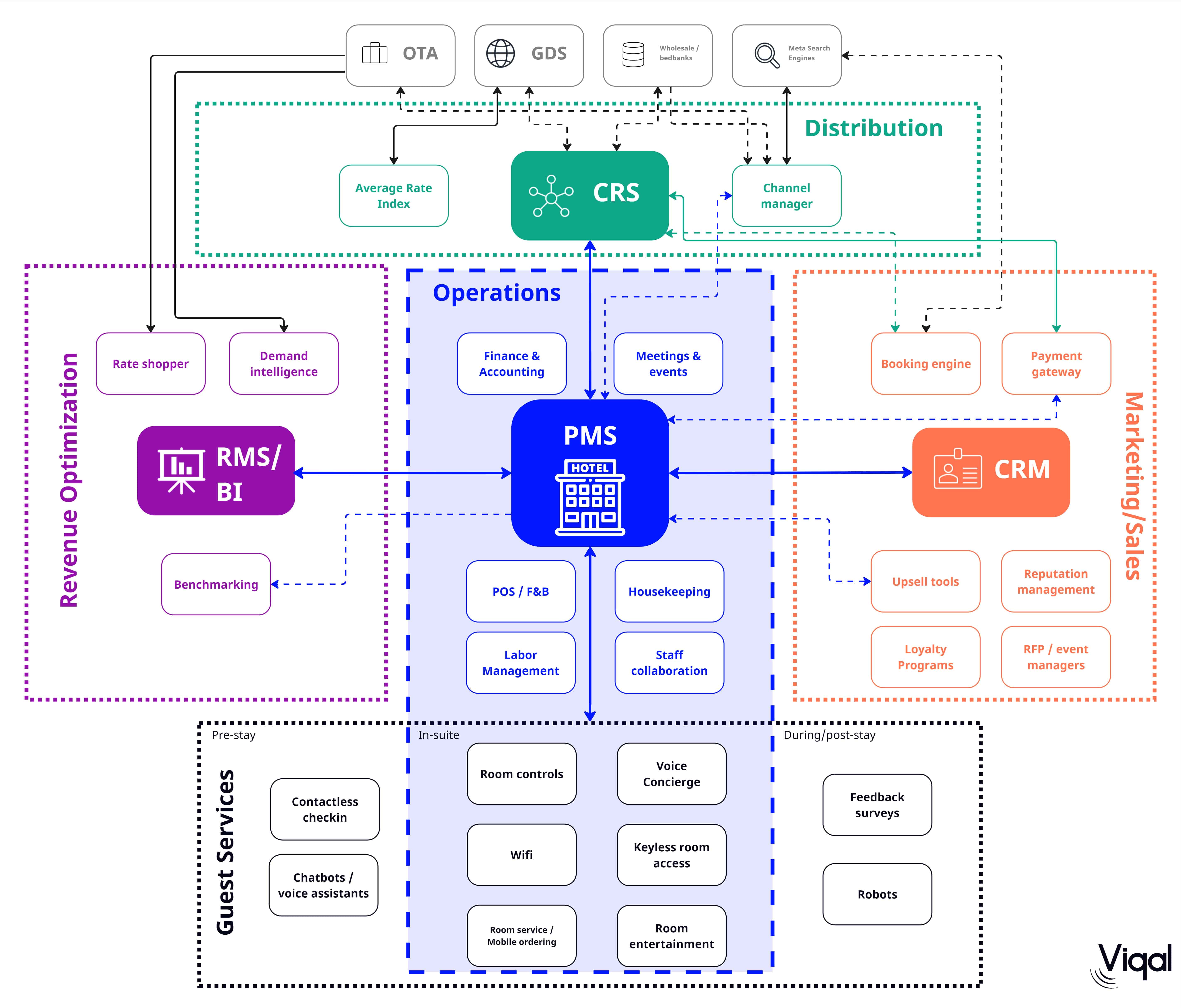
APIs are how hotel systems exchange information in real time. A booking made on Booking.com hits the channel manager (SiteMinder, Cloudbeds, or similar), which pushes the reservation into the CRS, which then writes it to the PMS. The POS posts a spa charge to the room folio without anyone walking a paper chit to the front desk. None of this is glamorous; it just needs to keep working at 3am on a Saturday. Below is what each integration is meant to do once it is in place.
Done well, these integrations remove a layer of manual data entry and let teams concentrate on guests rather than spreadsheets.
Beyond the plumbing, APIs are how a hotel actually personalises a stay. A CRM stitched into the PMS knows that the guest in 412 prefers a king bed, the room at 21C, and decaf in the morning. The front desk does not have to remember any of this; the data follows the guest. That is the practical version of personalisation. Most properties we work with capture roughly 30 to 50 useful preference fields per repeat guest, and use about ten of them. The examples below are what we see working in real operations rather than slide decks.
The operational case for good integrations is unglamorous but real: less double entry, fewer reconciliation calls between departments, fewer disputes at checkout. When a reservation lands, the PMS, housekeeping board and F&B systems update at the same time. Night audit closes faster. The duty manager spends time on the floor rather than chasing a missing folio charge. In our own deployments, we usually see roughly 4 to 6 hours per week of front-office time freed once core integrations are clean. That is the boring win, and it is the one finance directors actually care about.
Integrations look simple on a vendor slide and rarely are in practice. The recurring issues:
A few directions are clear enough to bet on:
Mostly this is about the existing stack working better together rather than chasing new categories.
APIs are not the headline. They are the wiring behind every other claim a vendor will make. If the wiring is poor, no amount of AI on top will save the operation. If the wiring is solid, fairly modest tools start producing real results. Before signing the next shiny contract, audit what you already have connected, where data is flowing both ways, and where it is silently broken. That single exercise tends to be worth more than the next purchase.
← Previous: Part 8: In-Room Technology | Next: Part 10: Data Security and Compliance →
.avif)
APIs are the connectors that let different systems in a hotel's tech stack share data. PMS, CRS and CRM platforms can communicate without manual re-keying, which keeps records consistent across systems instead of drifting apart over time.
Real-time data sharing across systems, less manual entry and fewer reconciliation errors. When a guest books, their record updates everywhere at once, so room readiness, housekeeping and check-in all run from the same source rather than three slightly different ones.
Pick integrations that are robust, secure and compatible with what is already in place, and that can extend to whatever comes next. Then monitor them. Most integration failures are silent, so quarterly checks matter more than the initial setup.
Documented REST or GraphQL endpoints, OAuth 2.0 authentication, sub-2-second response times, webhook support for real-time updates, sandbox environments for testing, and clear rate limits. Vendors that meet all six are integration-ready; those that don't will create technical debt.
List every connection between systems, document the data flowing each way, check authentication method and frequency, validate error handling, and confirm SLA terms with each vendor. Quarterly audits catch silent failures (data not flowing) that often go unnoticed for months and create reporting blind spots.
Buy when an off-the-shelf integration exists from a reputable vendor; building custom usually creates maintenance burden and integration debt. Build only for proprietary systems or when no vendor solution fits. Even then, build the integration as a standard service (REST or GraphQL) so it can be reused.
.avif)